
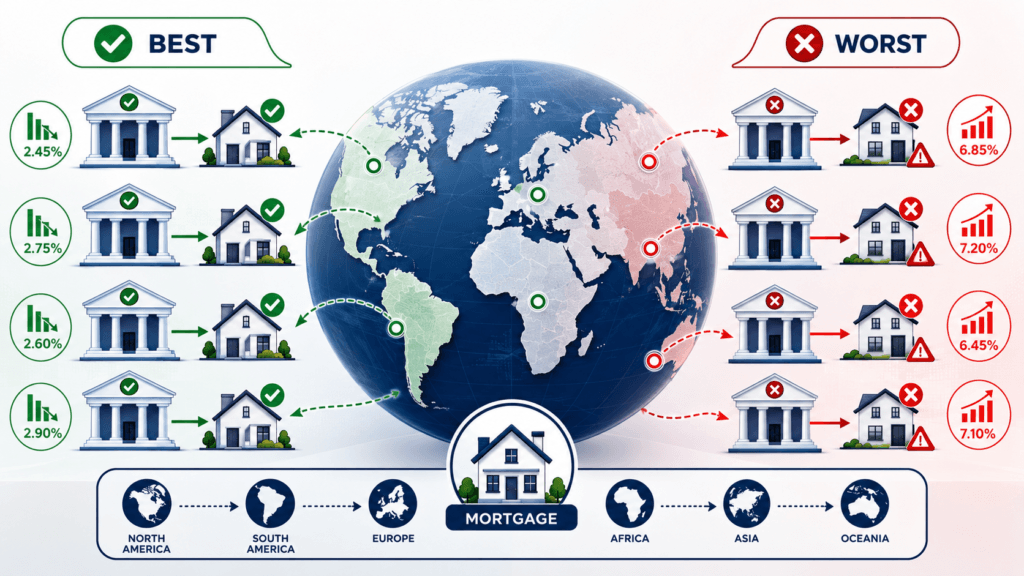
Securing a mortgage is one of the most consequential financial decisions a person can make — and the bank you choose to do it with matters as much as the property itself. Interest rates, loan-to-value limits, early repayment penalties, hidden fees, and customer service standards vary dramatically not only from country to country, but from institution to institution within the same market. In 2026, with monetary policy diverging sharply across the globe and mortgage markets at very different stages of maturity, knowing where to look — and what to avoid — is more important than ever.
This article analyzes the principal mortgage lenders across six major world regions, identifying the most reliable institutions for borrowers and those whose track records, fee structures, or market practices warrant caution.
North America: United States and Canada
The United States operates the world’s most liquid and competitive retail mortgage market. The current average 30-year fixed mortgage rate is 6.49% as of May 17, 2026, according to Bankrate’s national survey — elevated by historical standards, but declining from recent peaks.
Among American lenders, Navy Federal Credit Union consistently leads independent APR surveys, posting rates as low as 5.488% APR on 30-year conventional loans in recent weekly comparisons by Yahoo Finance. It is a member-owned institution with no shareholder profit motive, which structurally aligns its incentives with borrowers rather than investors. PenFed Credit Union and Chase Bank also rank highly across multiple 2026 evaluations, with Chase earning top marks from SmartAsset for product breadth, digital experience, and its nationwide 50-state coverage. Bank of America ranked first in J.D. Power’s 2025 Mortgage Servicer Satisfaction Survey, a meaningful signal for long-term borrower experience.
Less favorably regarded is Wells Fargo, which despite offering competitive rates carries an institutional reputation shadow from past legal settlements related to fraudulent account openings and mortgage servicing abuses. Prospective borrowers should approach it with due diligence. Rocket Mortgage, while the largest originator by volume, consistently appeared at the bottom of APR rankings in Yahoo Finance’s weekly surveys, with an APR gap of over 1.3 percentage points versus the top-ranked lender — a significant cost differential over a 30-year term.
In Canada, the major chartered banks — Royal Bank of Canada (RBC), TD Bank, Scotiabank, and Bank of Montreal (BMO) — dominate the market. All four are considered among the world’s most financially stable institutions by the Bank for International Settlements. Current 5-year fixed mortgage rates in Canada range from approximately 4.2% to 5.0%, lower than the US due to the Bank of Canada’s more accommodative rate path. RBC and TD consistently score highest in borrower satisfaction surveys conducted by J.D. Power Canada.
Latin America
Latin American mortgage markets are structurally constrained by high central bank policy rates, persistent inflation, and limited long-term funding mechanisms for lenders — factors that make home financing significantly more expensive than in developed markets.
In Mexico, BBVA México, Santander México, and the state-owned Infonavit housing fund dominate the mortgage landscape. Fixed rates from private banks currently range from approximately 10% to 12% annually. Infonavit, while restricted to formal sector workers, offers subsidized rates that are considerably more favorable. Santander México and BBVA have the broadest product range and most transparent fee disclosures.
Chile represents Latin America’s most sophisticated mortgage market. Banks like BancoEstado (state-owned), Banco de Chile, and Santander Chile offer mortgage products denominated in Unidades de Fomento (UF), an inflation-linked unit that provides real rate stability over time. Fixed real rates in Chile have historically ranged from 3% to 5% in UF terms, making Chilean mortgages among the most structurally sound in the region.
Brazil presents a starkly different picture. With the Selic rate having reached 14.75% in recent months, residential mortgage rates from banks like Caixa Econômica Federal, Banco do Brasil, and Itaú Unibanco are among the highest in the G20 world for a significant economy. Caixa, as the state-controlled housing bank, offers the most favorable terms under the Minha Casa Minha Vida social program, but even these rates carry substantial long-term cost. Argentina’s mortgage market remains functionally inaccessible for most buyers due to chronic macroeconomic instability.
Europe
Europe’s mortgage market is anchored by the ECB’s policy rate of 2.15%, which has pulled borrowing costs down significantly compared to the US. German fixed-rate mortgages currently range from 3.5% to 5% according to Wise’s 2026 market data, while UK rates — influenced by a higher Bank of England rate — sit somewhat above that band.
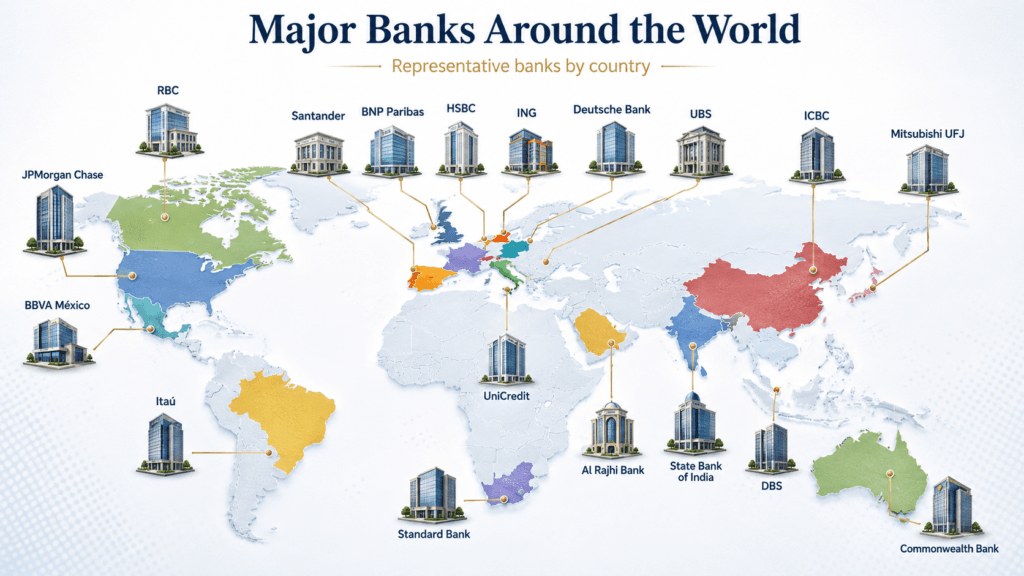
Among the continent’s most reliable lenders, HSBC UK earned the Global Finance Magazine “Best Bank in the United Kingdom 2026” distinction for the second consecutive year, supported by a 13.2% CET1 capital ratio and 19.2% return on tangible equity. It offers 2-year fixed mortgages from approximately 3.76% for prime borrowers. NatWest consistently leads UK rate surveys for first-time buyers, with the most competitive 2-year and 5-year fixed deals. UBS earned the “Best Bank in Switzerland” title from Global Finance for the sixth consecutive year. Banco Santander Totta (Portugal) posted a 31.8% return on tangible equity in 2025 — one of the highest in Europe — reflecting genuine operational efficiency.
ING (Netherlands/Germany) is widely cited for transparency, competitive rates, and digital accessibility across its EU operating markets. BNP Paribas (France) and Deutsche Bank (Germany) serve the institutional and high-value retail segment effectively but carry higher complexity costs for standard residential borrowers. In Spain, CaixaBank and BBVA offer the broadest retail mortgage distribution.
On the cautionary side, several Turkish banks — including the state-owned Ziraat Bankası and Halkbank — operate in a market where mortgage rates have exceeded 30% annually at various points, driven by erratic monetary policy. Turkish mortgages denominated in local currency have lost significant real value for lenders and created severe affordability crises for existing borrowers.
Africa
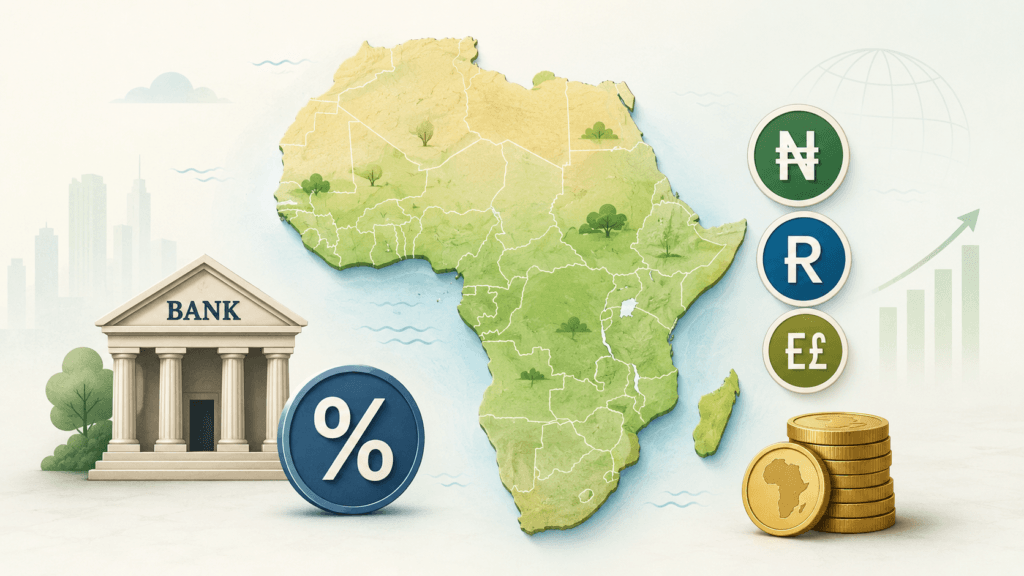
Africa’s formal mortgage market remains among the world’s least developed, with mortgage debt representing under 5% of GDP across Sub-Saharan Africa, compared to over 40% in Western Europe. High central bank rates, currency risk, land title insecurity, and limited credit bureau infrastructure combine to restrict access severely.
South Africa has the continent’s most functional mortgage market. Its four major lenders — FNB (FirstRand), Absa, Standard Bank, and Nedbank — offer home loans tied to the prime lending rate, currently approximately 11.25%. These banks apply robust credit assessment standards and offer fixed and variable options. FNB is consistently rated highest for customer service.
In Morocco, Attijariwafa Bank and CIH Bank offer mortgage rates of approximately 4% to 6%, among the most competitive on the continent, underpinned by a relatively stable macroeconomic environment and a formal property registry system.
In contrast, Nigeria’s mortgage market — despite reforms — remains essentially inaccessible to the majority of the population. Central Bank of Nigeria rates hovering around 27% make formal mortgage financing prohibitively expensive. The Federal Mortgage Bank of Nigeria (FMBN) provides subsidized access for government employees, but private sector availability remains marginal.
Kenya’s KCB Bank and Equity Bank offer mortgage products, but rates of 12% to 16% and stringent collateral requirements limit uptake to high-income borrowers.
Asia

Asia presents the world’s widest mortgage rate dispersion — from sub-1% variable rates in Japan to double-digit rates in parts of South Asia.
Japan remains the global outlier. Even following the Bank of Japan’s cautious rate normalization to 0.5%, the major lenders — Japan Housing Finance Agency, MUFG (Mitsubishi UFJ), and Japan Post Bank — offer variable-rate mortgages around 0.6% to 1.0% and fixed-rate products between 1.5% and 2.5%. These are among the lowest mortgage rates available anywhere in the world.
Singapore’s DBS, OCBC, and UOB offer SORA (Singapore Overnight Rate Average)-linked mortgages with total rates around 3.5% to 4.5%. All three rank highly in Asian banking stability assessments and transparency standards.
In India, the State Bank of India (SBI) and HDFC Bank dominate residential mortgage lending, with rates currently in the 8.5% to 9.5% range — elevated but declining as the Reserve Bank of India eases its policy stance.
China’s major state-owned lenders — ICBC, China Construction Bank, and Agricultural Bank of China — offer mortgages at around 3.5% to 4.0% following multiple rate cuts designed to stimulate the property sector.
Turkey again represents the region’s most challenging environment for mortgage borrowers, with rates that have exceeded 30% in recent periods, though currently declining.
Oceania
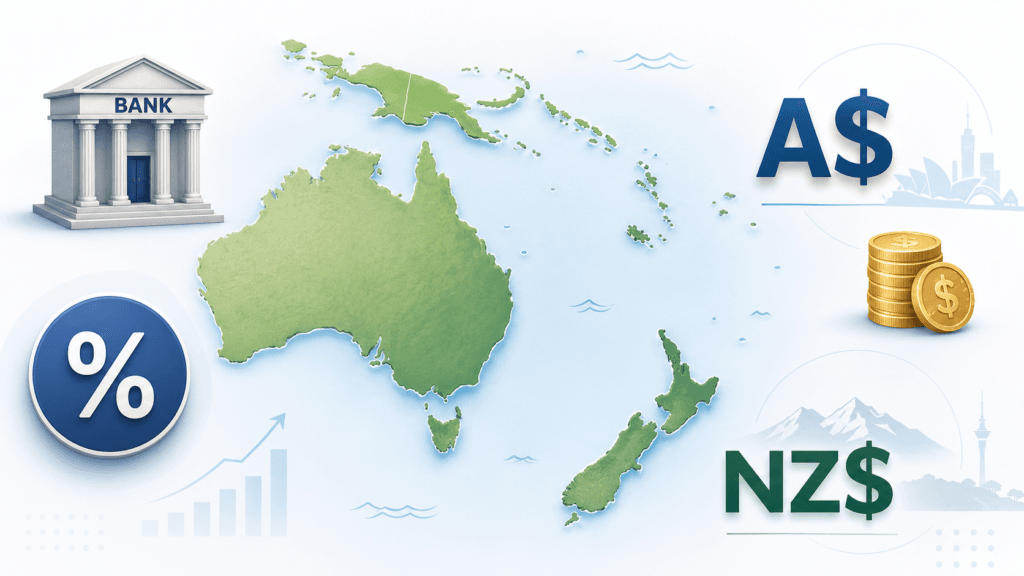
Australia’s mortgage market is dominated by the “Big Four” — Commonwealth Bank (CBA), ANZ, Westpac, and NAB — all of which are considered among the world’s most stable banking institutions by Moody’s and S&P. Approximately 70% of Australian mortgages carry variable rates, which currently sit around 6.0% to 7.0% following RBA policy adjustments. Fixed-rate products for 1 to 3 years range from 5.5% to 6.5%.
Commonwealth Bank is consistently rated highest for mortgage product range and digital experience. ANZ is the most active in New Zealand cross-market lending. The major risk in the Australian market is rate sensitivity: with such a high proportion of variable-rate holders, any RBA rate increase passes through almost immediately to household repayment costs — a structural vulnerability that regulators have noted explicitly.
Global Summary
The world’s mortgage markets reflect a profound divergence in 2026. Japan offers the cheapest home financing on the planet. Western Europe — particularly Germany, Switzerland, and the Netherlands — provides the most structurally sound and transparent mortgage frameworks. North America delivers the broadest product competition. Latin America and Africa remain constrained by high rates and institutional limitations, though islands of relative stability exist in Chile, Morocco, and South Africa. Asia’s established financial centers (Singapore, Japan) outperform their emerging-market peers dramatically.
For any borrower — whether domestic or international — the universal principle applies: compare by APR, not advertised interest rate; verify the fee structure before signing; and prioritize institutions with publicly audited financial strength and independent customer satisfaction data.
Comparative Summary Table
| Region | Top Recommended Banks | Notable Caution | Typical Mortgage Rate (2026) |
|---|---|---|---|
| USA | Navy Federal CU, Chase, Bank of America, PenFed | Wells Fargo (past legal issues), Rocket Mortgage (high APR) | 5.5%–6.5% (30yr fixed) |
| Canada | RBC, TD Bank, Scotiabank, BMO | — | 4.2%–5.0% (5yr fixed) |
| Latin America | Santander Chile, BancoEstado (CL), BBVA México, Infonavit (MX) | Itaú/Bradesco Brazil (high rates), all Argentine banks | 4%–6% (Chile); 10%–15% (Brazil/Mexico) |
| Europe (West) | HSBC UK, NatWest, UBS, ING, BNP Paribas, CaixaBank | Turkish banks (Ziraat, Halkbank) | 3.5%–5.0% |
| Africa | FNB/Absa/Standard Bank (SA), Attijariwafa (Morocco) | FMBN Nigeria (inaccessible), most Sub-Saharan lenders | 4%–6% (Morocco); 11%+ (South Africa) |
| Asia | DBS/OCBC/UOB (SG), MUFG/Japan Post (JP), SBI (IN) | Turkish banks, Pakistani lenders | 0.6%–1% (Japan); 3.5%–4% (China); 8.5%–9.5% (India) |
| Oceania | Commonwealth Bank, ANZ, Westpac, NAB | — | 5.5%–7.0% (variable, Australia) |
Disclaimer: This article is for informational and educational purposes only and does not constitute financial, investment, or legal advice. Mortgage rates, bank rankings, and regulatory conditions change frequently and vary by individual borrower profile, credit history, loan amount, and jurisdiction. Data referenced is based on publicly available sources as of May 2026. Rankings reflect general market reputation and publicly reported metrics — not personalized financial recommendations. Always conduct your own due diligence and consult a licensed financial advisor or mortgage professional in your country before making any borrowing decision.