
Should you buy a house now or wait for mortgage rates to drop in 2026? Here is the real math behind affordability, rates, home prices, inventory, refinancing, and the hidden cost of waiting.

Introduction: The Question Every Buyer Is Asking in 2026
For millions of Americans, the hardest part of buying a home in 2026 is not finding a house.
It is deciding whether to move at all.
Mortgage rates are still high compared with the ultra-low-rate years. Home prices remain expensive in many markets. Inventory has improved in some areas, but not enough everywhere. Buyers are stuck between two uncomfortable choices:
Buy now and accept a higher mortgage payment.
Wait and hope rates fall — while prices, competition, or rent may rise.
This is the central housing question of 2026:
Should you buy now or wait?
The honest answer is not emotional. It is mathematical.
A lower mortgage rate can save money, but waiting can also cost money if home prices rise, inventory tightens, or competition returns. At the same time, buying too soon can be dangerous if the monthly payment stretches your budget beyond safety.
As of May 14, 2026, Freddie Mac reported the average U.S. 30-year fixed mortgage rate at 6.36%, down from 6.81% a year earlier. The 15-year fixed mortgage averaged 5.71%. Rates have improved slightly from 2025, but they are still far above the 3% mortgages many homeowners locked in during the pandemic era.
That means buyers in 2026 need to stop asking, “Will rates drop?”
The better question is:
If rates drop, will waiting actually make the home cheaper for me?
That answer depends on five numbers: mortgage rate, home price, down payment, monthly payment, and time.
If you want to know which buyer profile you fall into and how to actually negotiate the best rate once you decide to buy, see Who Should Buy Now, Who Should Wait, and How to Find the Best Deal.
The 2026 Housing Market: Better Than 2025, Still Not Easy
The 2026 housing market is not frozen, but it is not cheap.
Existing home sales remain weak by historical standards. Reuters reported that U.S. existing home sales rose only 0.2% in April 2026 to a seasonally adjusted annual rate of 4.02 million units, below expectations. The median home price reached a record $417,700, while affordability remained a major challenge for buyers.
That tells us something important.
Demand is not booming. Buyers are cautious. But prices have not collapsed nationally.
This is the frustrating reality: high mortgage rates slowed the market, but low inventory and household demand have kept prices resilient in many areas.
There are regional differences. Some Southern and Midwestern markets have seen more listings and softer pricing. Expensive coastal markets remain difficult. Some local markets give buyers negotiating power. Others still punish hesitation.
So the decision to buy now or wait cannot be made at the national level. It has to be made locally.
A buyer in Austin, Tampa, Phoenix, or parts of the Midwest may face a very different market from a buyer in Boston, Los Angeles, Seattle, or Northern New Jersey.
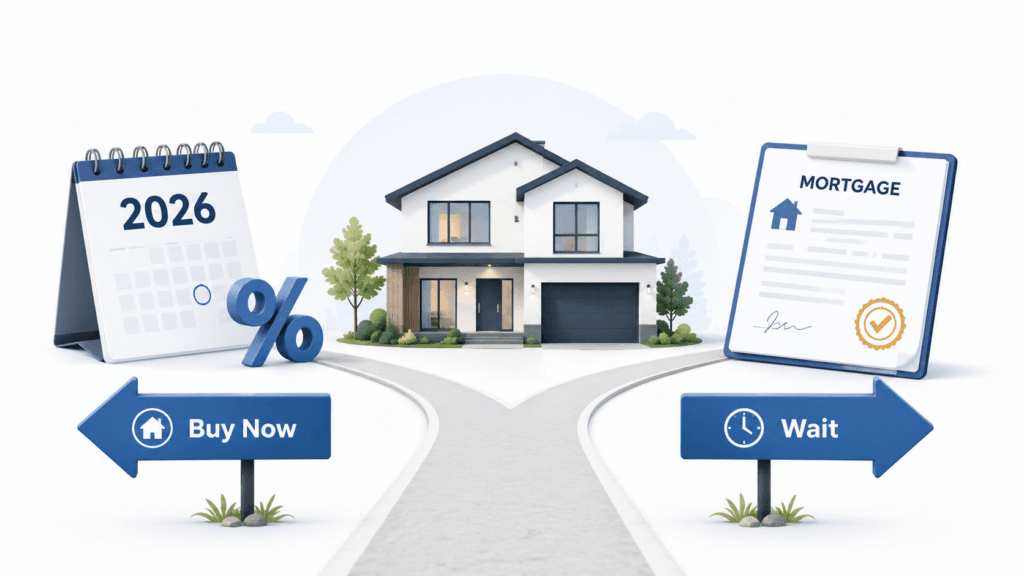
Will Mortgage Rates Drop in 2026?
Most forecasts point to gradual improvement, not a dramatic collapse.
Fannie Mae’s April Housing Forecast projected the average 30-year fixed mortgage rate at 6.3% in Q2 2026, 6.2% in Q3, and around 6.1% for the rest of 2026 and 2027, according to reporting on the forecast.
That matters because many buyers are waiting for a return to 4% or 5%.
That may not happen quickly.
The Mortgage Bankers Association has also projected a modestly better mortgage market in 2026, with purchase originations expected to rise 7.7% and refinance originations expected to rise 9.2% compared with 2025. But that forecast does not imply a return to ultra-low mortgage rates. It suggests a market slowly thawing, not suddenly becoming cheap.
Mortgage rates are influenced by inflation, Federal Reserve policy expectations, the 10-year Treasury yield, and mortgage-backed securities pricing. A buyer cannot control any of those variables.
So waiting purely because “rates might drop” is not a plan.
It is a bet.
Sometimes that bet pays. Sometimes it does not.
The Math: How Much Does a Lower Rate Actually Save?
Let’s use a simple example.
Assume:
- Home price: $420,000
- Down payment: 10%
- Loan amount: $378,000
- Mortgage term: 30 years
- Current rate: 6.50%
At 6.50%, the principal and interest payment is roughly $2,389 per month.
If the rate drops to 6.00%, the payment falls to about $2,266 per month.
That is a savings of about $123 per month, or $1,476 per year.
That is real money. But it may not be enough to justify waiting if the home price rises.
Now imagine the same house rises from $420,000 to $435,000 while the buyer waits.
With 10% down, the new loan amount becomes $391,500.
At 6.00%, the payment is roughly $2,347 per month.
The buyer waited for a lower rate, but because the price rose, the payment is only about $42 lower than buying earlier at 6.50%.
That is the trap.
A lower rate does not automatically mean a cheaper home.
Simple comparison
| Scenario | Home Price | Rate | Loan Amount | Estimated Principal & Interest |
|---|---|---|---|---|
| Buy now | $420,000 | 6.50% | $378,000 | About $2,389 |
| Wait, rate drops | $420,000 | 6.00% | $378,000 | About $2,266 |
| Wait, rate drops but price rises | $435,000 | 6.00% | $391,500 | About $2,347 |
The lesson is sharp:
Waiting only works if rates fall faster than home prices rise.
The Hidden Cost of Waiting: Rent
Many buyers compare mortgage payments but forget rent.
If you wait 12 months and pay $2,200 per month in rent, you spend $26,400 before buying.
That does not mean buying is automatically better. Rent buys flexibility. Rent may be smarter if you are not ready, not stable, or unsure about staying in the area.
But rent is still a cost.
A buyer waiting for rates to drop should ask:
- How much rent will I pay while waiting?
- How much more will I save for a down payment?
- Will home prices rise or fall in my target area?
- Will my income improve?
- Will my credit score improve enough to qualify for a better rate?
- Will I still be able to buy the type of home I want?
Waiting is not free. It is a strategy with carrying costs.
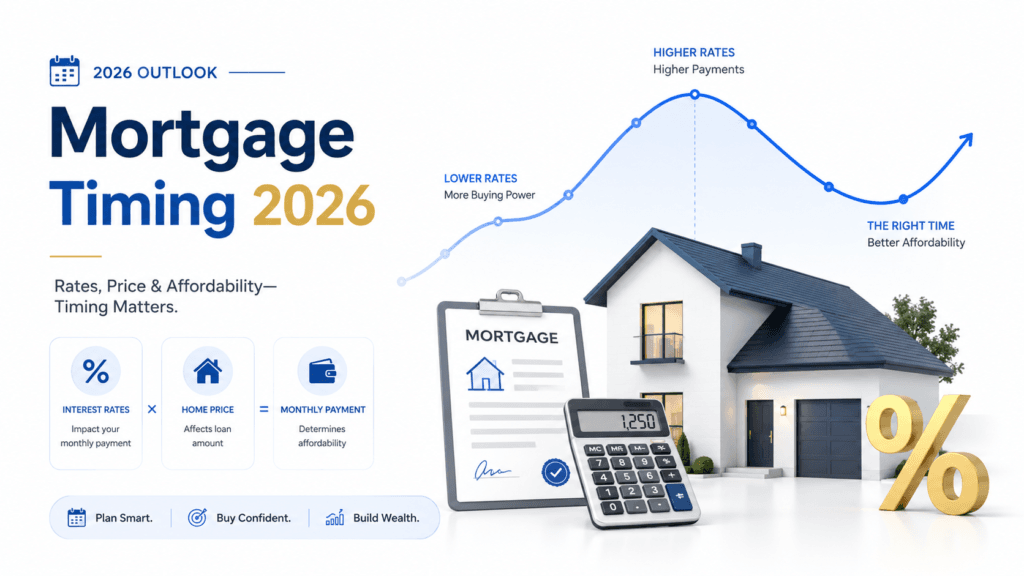
The Hidden Benefit of Waiting: Better Preparation
Waiting can be smart if you use the time well.
The best reason to wait is not “maybe rates will fall.”
The best reason to wait is:
I can become a stronger borrower.
A buyer who waits six to twelve months may be able to:
- raise their credit score,
- reduce credit card debt,
- increase the down payment,
- build cash reserves,
- improve debt-to-income ratio,
- avoid private mortgage insurance,
- qualify for a better loan,
- or move into a stronger employment position.
That can matter more than a small rate drop.
For example, a buyer with a 670 credit score may receive worse terms than a buyer with a 740 score. Improving credit can reduce the mortgage rate, lower costs, and increase approval strength.
The strongest buyer in 2026 is not necessarily the one who waits longest.
It is the one who waits with a plan.
Buy Now If the Payment Works Without Hope
This is the cleanest rule in the article:
Buy now only if the payment works today.
Do not buy based on the hope that rates will fall later.
A common phrase in real estate is: “Marry the house, date the rate.”
There is some truth in it. You can refinance a mortgage if rates fall and you qualify. But you cannot refinance a payment you cannot afford now.
Refinancing is not guaranteed. It depends on:
- future rates,
- home value,
- credit score,
- income,
- employment,
- loan-to-value ratio,
- closing costs,
- and lender approval.
If you buy at 6.5% and rates fall to 5.75%, refinancing might help. But if home values fall, your credit worsens, or your income drops, you may not qualify.
So the safe version of “buy now, refinance later” is:
Buy only if you can afford the current mortgage — and treat future refinancing as a bonus, not a rescue plan.
That distinction matters.
Wait If the Payment Forces You to Live on the Edge
If the mortgage payment consumes too much of your income, waiting is not cowardice.
It is discipline.
A house can become a financial trap if the payment leaves no room for repairs, insurance increases, property tax changes, emergencies, childcare, healthcare, job loss, or car replacement.
A buyer should not calculate affordability using only principal and interest.
The real monthly housing cost includes:
- principal,
- interest,
- property taxes,
- homeowners insurance,
- HOA fees,
- mortgage insurance,
- utilities,
- maintenance,
- repairs,
- and emergency savings.
A roof does not care that you stretched to buy the house.
Neither does a water heater.
A realistic homeowner budget should assume maintenance costs. Many financial planners use a rough rule of 1% of the home value per year for maintenance, though actual costs vary widely by age, location, climate, and condition.
On a $420,000 home, that could mean setting aside around $4,200 per year, or $350 per month, over time.
If the mortgage only works by ignoring maintenance, it does not work.
Inventory: The Variable Buyers Forget
Waiting for rates to drop can create a second problem: competition.
If mortgage rates fall meaningfully, more buyers may return to the market. That can increase bidding pressure, reduce seller concessions, and push prices higher.
In other words, the buyer waiting for lower rates may not be alone.
When rates are high, fewer buyers can afford to compete. That can create opportunities:
- more seller concessions,
- price reductions,
- longer days on market,
- inspection flexibility,
- rate buydown negotiations,
- closing cost credits,
- less bidding-war pressure.
In some markets, a buyer today may be able to negotiate terms that disappear when rates fall.
This is why “wait for lower rates” is not always the winning move.
A lower rate in a hotter market may not beat a higher rate in a cooler market with a better negotiated price.
Seller Credits and Rate Buydowns: The 2026 Opportunity
One of the most useful strategies in 2026 is asking sellers for credits.
A seller credit can help pay closing costs or fund a temporary or permanent rate buydown. This may be especially useful in markets where homes are sitting longer.
A temporary buydown may reduce payments for the first one to three years. A permanent buydown uses upfront funds to lower the interest rate for the life of the loan.
But buyers must be careful.
A temporary buydown is not the same as true affordability. If the payment rises after year one or year two, the buyer must qualify mentally and financially for the full future payment.
A seller-paid permanent buydown can be more valuable if the buyer plans to stay long-term and the math beats a simple price reduction.
The buyer should ask the lender to compare:
- price reduction,
- closing cost credit,
- temporary buydown,
- permanent buydown,
- and buying without concessions.
The best deal is not always the biggest headline discount. It is the lowest realistic cost over the buyer’s expected ownership period.
The Refinance Option: Helpful, but Not Free
If you buy now and rates fall later, refinancing may reduce your payment.
But refinancing has costs.
Those costs can include origination fees, appraisal, title, recording, escrow, prepaid items, and other closing costs. The key calculation is the break-even point.
Refinance break-even = refinance costs ÷ monthly savings
If refinancing costs $5,000 and saves $250 per month, the break-even point is 20 months.
That means the refinance only produces net savings if you keep the new loan long enough to recover the upfront cost.
This is important for 2026 buyers. Buying now with the plan to refinance later can work, but only if the initial payment is affordable and future refinancing costs make sense.
The Decision Framework: Buy Now or Wait?
Here is the practical framework.
Buy now may make sense if:
- you can afford the payment at today’s rate,
- you have stable income,
- you plan to stay at least five to seven years,
- your target market has more inventory,
- sellers are negotiating,
- you have emergency savings after closing,
- and the home fits your long-term needs.
Waiting may make sense if:
- the payment is too tight,
- you need to improve credit,
- you need a larger down payment,
- your job or location is uncertain,
- your target market is overpriced,
- you expect local prices to soften,
- or you would be relying on refinancing to survive.
The key word is local.
National forecasts are useful, but you buy a specific home in a specific ZIP code. A national rate forecast cannot tell you whether your local seller will cut $20,000, accept closing credits, or receive five offers next weekend.
The Real Math Formula
Here is the simplified formula every buyer should use:
Cost of buying now vs cost of waiting =
Today’s payment + today’s price + negotiation power
compared with
future rate + future price + rent paid while waiting + future competition
Put simply:
Waiting is smart only if it improves your total position.
Not just the rate.
Your total position includes payment, price, cash reserves, credit score, inventory, concessions, and life stability.
A lower rate with a higher price may not help.
A higher rate with a lower price and seller credits may.
A lower payment that leaves no emergency fund is not safe.
A delayed purchase that lets you clear debt and strengthen your credit may be brilliant.
Final Verdict: The Smart Buyer Does Not Guess
So, should you buy now or wait in 2026?
The answer is:
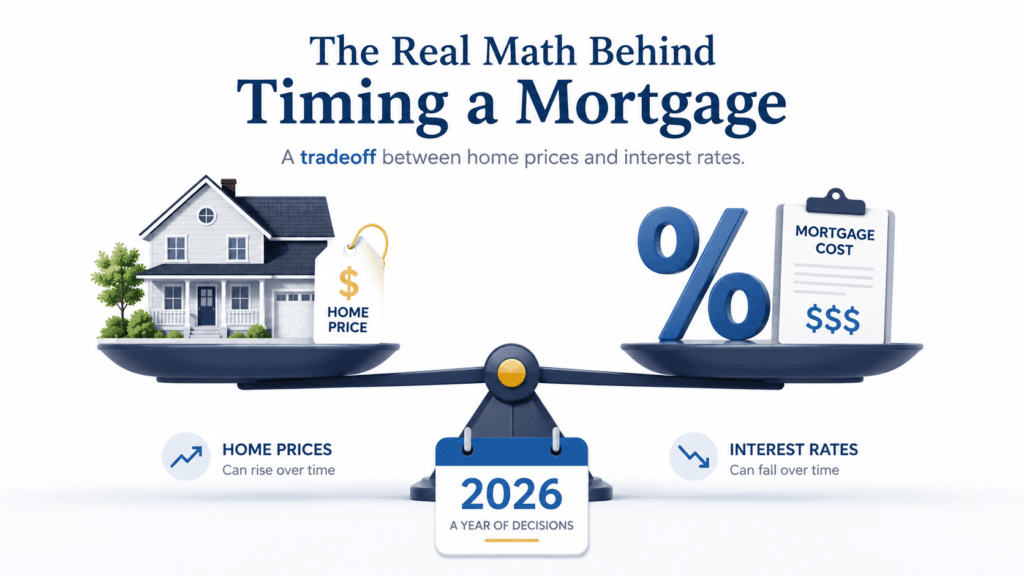
Buy when the home, payment, and life plan all work at today’s numbers.
If rates fall later, refinancing can become an opportunity. But it should never be the only reason the purchase works.
Waiting can be smart if it makes you stronger. Waiting can be dangerous if you are only hoping for a rate drop while prices, rent, and competition move against you.
Buying now can be smart if you find the right home, negotiate well, and can afford the payment. Buying now can be reckless if the numbers only work in a fantasy where rates fall quickly.
In 2026, the winning buyer is not the fastest buyer.
It is not the most optimistic buyer.
It is the buyer who runs the math while everyone else argues with headlines.
The mortgage rate matters.
But the full equation matters more.