This article is for general information only and is not financial or legal advice. Lender terms, fees, and underwriting rules vary and change. Always check each lender’s own disclosures before you apply.
There is a way to compare real, personalized loan offers from a dozen lenders at once, see the actual rate each one would give you, and pick the best deal, all without your credit score losing a single point. Most borrowers assume no such thing exists, or that it has to be a gimmick. It is not. It is a standard part of how lending works today, and it has a name: soft-pull loan prequalification.
The fact that most people never use it is one of the most expensive habits in personal finance. When someone needs money fast, whether to tackle high-interest credit card debt or fund a home upgrade, the usual approach is backward. They fire off several full applications across different lender sites out of urgency, and each one triggers a hard inquiry that chips away at their credit exactly when they need their borrowing power at its strongest.
This guide walks through how prequalification actually works behind the scenes. We will lay out the real difference between hard and soft credit checks, show you the quirk in the FICO model that traps personal loan shoppers specifically, and give you a clear, step-by-step way to shop the market with confidence, protect your score, and make sure your next loan works for you instead of quietly draining your budget.
The Soft Prequalification Check
A basic review of your data. Lenders check your credit background and internal risk tiers without registering a credit-seeking event on your credit report.
The Hard Formal Application
An official credit review submitted to the bureaus. It confirms full documentation, stays visible on your credit history for 24 months, and can lower your scores.
Getting this distinction right is the first defensive move in managing your credit. Let’s look directly at how the two checks work, and why mastering the difference protects your finances.
1. What Is a Soft Pull, and Why Does It Matter?
When a lender reviews your credit file to judge you as a borrower, it can do so in two completely distinct ways: a soft inquiry or a hard inquiry. Not knowing the difference between them can have immediate consequences for your plans.
The Background Nature of Soft Inquiries
A soft credit check is an information-gathering step. It happens when a lender looks at your basic credit profile to see whether your history matches their standard underwriting tiers. Because a soft pull is not tied to an active, finalized request for a specific line of credit, it is never reported as a credit-seeking event to the primary credit bureaus (Equifax, Experian, and TransUnion).
That means soft inquiries are invisible to other lenders looking at your file. They have an absolute zero point impact on your active credit scores. Soft pulls actually happen constantly in the background of your financial life without your involvement, such as when a card company checks your profile to send a pre-approved offer, or when you pull your own report through a monitoring app. For the official rules on how lenders may check your credit and what rights you have as a borrower, the CFPB’s consumer resources on personal loans are a solid starting point.
The Structural Impact of Hard Inquiries
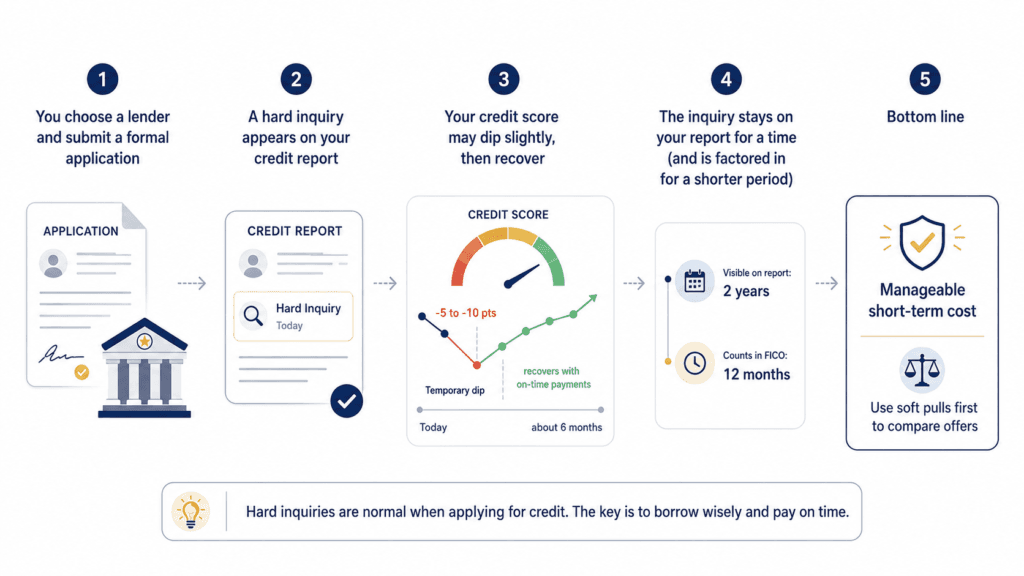
A hard credit check is an official request submitted to the bureaus when you complete a formal application for credit. It tells the system you are actively taking on new debt. The entry logs on your file immediately and stays visible to any lender who reviews your background over the next two years.
Because a sudden run of new debt requests can signal rising risk, the FICO model docks your score for each hard check, usually a temporary drop of 5 to 10 points per inquiry. Apply with several lenders at once, and those individual drops stack up fast, creating a real downward trend across your whole profile.
If a borrower formally applies with five different personal loan providers in a short window, they risk a 25 to 50 point drop on their profile. A drop that size can push an applicant down an entire underwriting tier, shifting them from “Good Credit” to “Fair Credit.” That downward move can mean noticeably higher long-term interest rates on the exact financing they are trying to secure.
Before you start any application, it is worth knowing where your credit sits relative to the boundaries lenders draw. Our guide to the credit score tiers lenders use to price your risk, and how a 40-point gap costs thousands lays out the exact parameters used to price consumer risk.
2. The Hidden Trap Inside the FICO Personal Loan Algorithm
Here is a nuance most borrowers miss: personal loan applications do not get the rate-shopping protection that mortgages and auto loans do.
When you shop for a mortgage or an auto loan, the FICO model is built to be relatively forgiving. It recognizes that buying a home or a car means comparing offers across lenders, so it groups multiple mortgage or auto inquiries that fall within a 14 to 45-day window into a single scoring event. That lets you cross-shop several banks without damaging your score.
If you are also weighing a home purchase this year, those grouping rules can save you real money. Our complete 2026 U.S. mortgage guide covers how to line up your rate shopping so it counts as one inquiry, not ten.
The personal loan market plays by different rules. The FICO model does not offer a rate-shopping window for personal installment loans. Every formal application you send to a personal loan lender is treated as its own isolated, independent credit-seeking event.
Submit five formal applications to five personal loan lenders in one afternoon, and you trigger five separate hard inquiries and take five separate hits. That single structural difference is exactly why the soft-pull prequalification approach is not an optional tip here. It is a necessity.
3. How the Prequalification Engine Actually Works
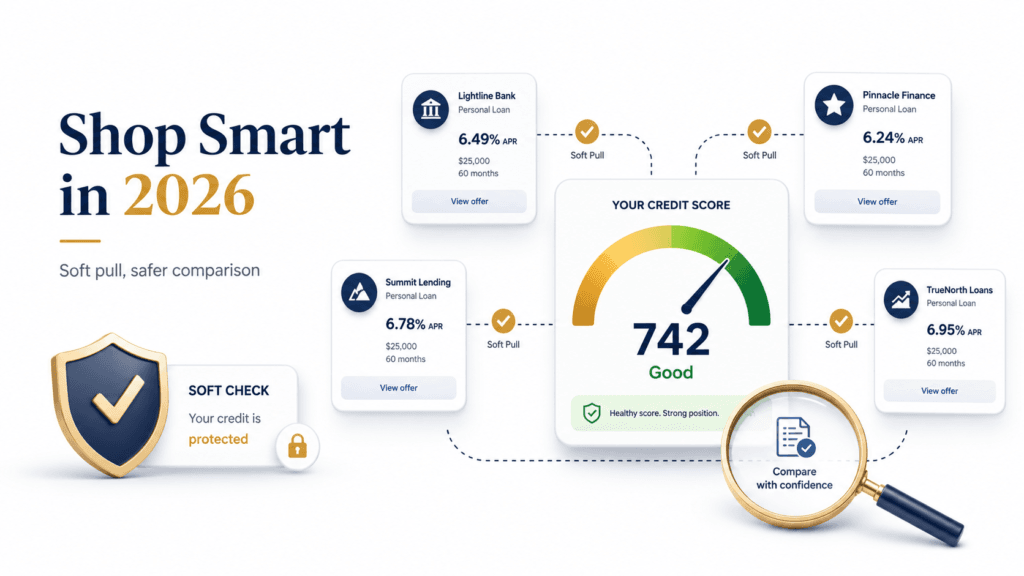
Soft-pull prequalification solves the problem by letting a lender build you a personalized offer without triggering a hard inquiry. Here is what happens behind the scenes:
1. Soft Data Intake
You provide basic identifiers, your address, your stated gross annual income, and the loan size you want. The lender runs a soft check to view your file without creating an official entry on your bureau history.
2. Automated Risk Assessment
The lender’s underwriting software checks your risk metrics, debt-to-income balance, and payment history against its specific credit tiers to decide whether you fit.
3. The Conditional Offer
If your profile clears their criteria, the platform generates a real, personalized offer with your projected APR, approved amount, and repayment term options, all with zero impact on your score.
Keep in mind that a prequalification offer is not a binding guarantee of final approval. It is a highly accurate preview. The final terms get confirmed in the next stage, where the lender runs a hard check to verify your full documentation, employment, and identity.
To turn those prequalified offers into smooth final approvals, it pays to tidy up your credit first and to be clear about why you are borrowing. If the goal is to roll several high-rate balances into one lower payment, our guide to the exact math behind consolidating with a personal loan shows whether the move actually saves you money before you apply.
4. The 2026 Reference Guide: Major Soft-Pull Lenders
The personal lending market splits between fintech platforms that use soft-pull prequalification for initial quotes and traditional banks that may require a formal application right away.
The table below shows the fee structures, prequalification paths, and top advertised APRs across major providers:
| Lending Institution | Soft-Pull Available? | Hard Inquiry Trigger Point | Origination Fee Scale | Maximum Advertised APR |
|---|---|---|---|---|
| SoFi | Yes | Upon formal application submission | 0.00% (fee-free model) | 29.99% APR |
| Marcus (Goldman Sachs) | Yes | Upon formal application submission | 0.00% (fee-free model) | 24.99% APR |
| Discover | Yes | Upon formal application submission | 0.00% (fee-free model) | 24.99% APR |
| LendingClub | Yes | Upon formal application submission | 1.00% to 8.00% | 35.99% APR |
| Upgrade | Yes | Upon formal application submission | 1.85% to 9.99% | 35.99% APR |
| Upstart | Yes | Upon formal application submission | 0.00% to 12.00% | 35.99% APR |
| Best Egg | Yes | Upon formal application submission | 0.99% to 9.99% | 35.99% APR |
| LightStream | No | Triggers hard pull immediately at entry | 0.00% (fee-free model) | 25.49% APR |
| Credible (marketplace) | Yes (one pull) | Bypassed until committing to one lender | Varies by partner lender | Varies by partner lender |
| MoneyLion (marketplace) | Yes (one pull) | Bypassed until committing to one lender | Varies by partner lender | Varies by partner lender |
The table shows that while most prominent digital platforms use soft pulls to protect your credit during the shopping phase, outliers like LightStream skip prequalification entirely and run a hard check the moment you enter your details. That makes reading each platform’s terms essential. Rates and fee ranges shift, so treat these as a snapshot and confirm current figures on each lender’s own site before you rely on them.
5. The Marketplace Shortcut: Many Offers From a Single Soft Pull
If visiting individual lender sites and re-entering your data over and over feels like too much friction, there is a faster route: loan comparison marketplaces.
Platforms like Credible, MoneyLion, and similar aggregators sit between you and a broad network of partner banks. Instead of filing separate requests, you fill out one prequalification profile with your stated gross income, employment status, housing costs, and target loan size.
The marketplace pushes that single profile out to dozens of underwriters at once, performing one collective soft credit pull. Within minutes, your dashboard fills with real, prequalified offers tailored to your history, each showing its APR, origination adjustments, monthly payment, and terms side by side.
This approach is especially useful when you are not sure which platforms are likely to approve you, or when you just want to scan several options quickly before narrowing down to a single lender.
Marketplace prequalification tools shine when you are folding short-term debts into a single, structured payoff. If you are juggling several revolving balances and want to cut your total borrowing cost, our guide on whether a personal loan or a credit card costs more, and when each one makes sense helps you pick the right tool for your plan.
6. Spotting Deceptive Lender Jargon
As you move between platforms, learn to notice that not every lending page uses these terms the same way. Some lenders put “prequalification” or “pre-approval” on their marketing banners as a hook, while burying a hard inquiry authorization inside the consent agreement. The FTC’s rules on deceptive credit practices exist precisely because this kind of bait-and-switch is common.
To protect your credit against hidden checks, run this quick verification before clicking any submit button:
- Read the disclosure text near the button. If the page says “Checking your customized rates will not affect your credit score,” or “We use a soft inquiry to show your options,” you are on a safe prequalification track.
- Watch for hard-pull warning signs. If the fine print reads “By clicking submit, you authorize this institution to obtain a full consumer credit report from Equifax or Experian,” or the system makes you upload W-2 forms or pay stubs during the first step, you are probably triggering a formal hard check. Step back and look for a more transparent platform.
If a platform hides how it verifies your data, treat that lack of transparency as a preview of how it does business, and move toward lenders that respect your credit health.
7. The Step-by-Step Action Plan
To find the most competitive terms on the market while keeping your score secure, run this three-phase plan:
Phase 1: Broad Prequalification Shopping
Set aside a single afternoon to collect quotes. Use a comparison marketplace or individual soft-pull lender sites (SoFi, Discover, Marcus) and complete their prequalification profiles. Keep it to four to six transparent platforms. This takes under thirty minutes, keeps your file safe, and gives you a stack of real, personalized offers.
Phase 2: Total Cost Analysis
Look past the headline interest rate and compare each offer by its Annual Percentage Rate (APR). The APR folds in both the base interest and any front-loaded origination fee, so it shows your true long-term cost.
Watch the fee interaction: a lower interest rate paired with a steep origination fee may not be your cheapest path if you plan to pay the loan off early. Our breakdown of why the advertised rate is almost never what you actually pay shows how those fees change the real number.
Phase 3: One Focused Formal Application
Once you have isolated the single offer with the lowest true APR and the most comfortable terms, move ahead with that one lender. Submit the formal application and your income documents. This triggers a single hard inquiry and a minor, temporary 5 to 10-point dip, a small and short-lived cost for locking in the best rate available.
8. What Happens After the Hard Pull?
Once you commit and authorize the formal application, that hard inquiry shows up on your bureau files. Hard checks stay visible on your history for a full 24 months, but their effect on your active scores typically fades after 12 months.
In most cases, the minor dip is fully recovered within six months of steady, on-time payments. As you pay down the principal, you also improve your credit utilization and add positive payment history, strengthening your file for whatever you finance next.
Locking in a good rate is only half the job. The loan agreement is where the real cost lives, in the origination fee, the prepayment penalty, and the clause that can permanently raise your rate after one late payment. Our guide to the 9 personal loan clauses that can quietly cost you thousands walks through exactly what to check before you sign.
Bottom line: soft-pull prequalification is not a loophole or a trick. It is a consumer protection system working the way it should, giving you clear data to make an informed choice before you commit your money. Shop smart, protect your score, compare total costs, and you can navigate the credit market without leaving your financial footing worse than you found it.
Keep Building on a Strong Credit Profile
Do not let hidden fees or unoptimized applications slow you down. These guides go deeper on protecting your score, choosing the right lender, and getting out of high-cost debt: