
AI and machine learning models now decide credit outcomes at scale. Understanding what these systems use, where they fail, and how to respond is essential for every borrower.
The rise of algorithmic underwriting
Over the past decade lenders have shifted from manual underwriting and simple rule‑based scoring toward automated, data‑driven systems. By 2026 a majority of banks, fintechs, and alternative lenders use machine learning models to evaluate applications, price loans, and automate approvals. These systems promise speed, lower operational costs, and the ability to evaluate applicants who fall outside traditional credit profiles. For many consumers—gig workers, recent immigrants, small business owners—algorithmic underwriting can open access to credit that would otherwise be unavailable.
But the same features that make AI attractive—complexity, reliance on large datasets, and automated decisioning—also create new risks. Models can be opaque, trained on biased or incomplete data, and deployed without adequate oversight. When a decision affects someone’s ability to rent, buy, or run a business, opacity and error are not academic concerns: they have real financial and legal consequences.
What AI credit scoring systems actually use
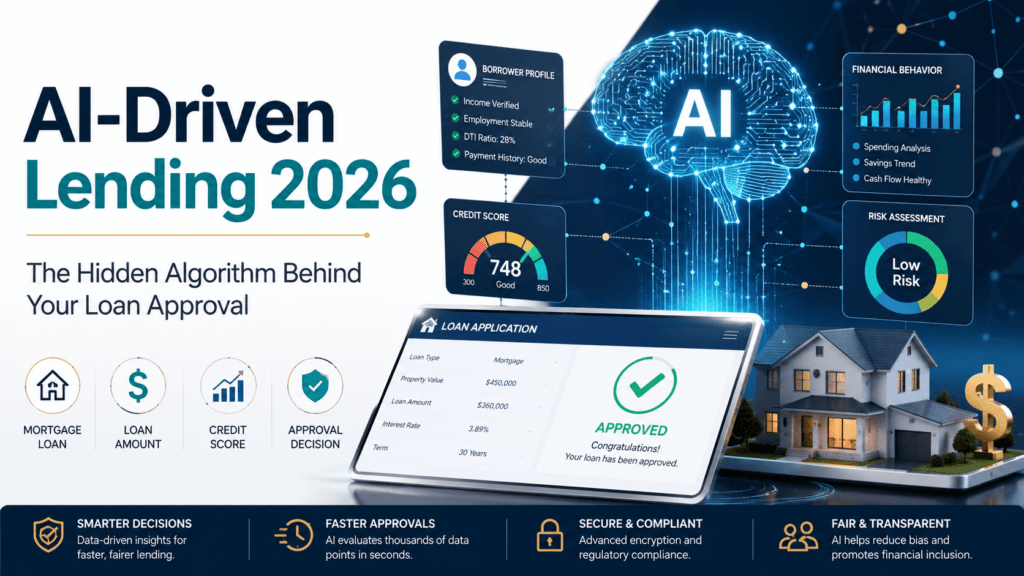
AI credit systems combine traditional and alternative data sources. Typical inputs include:
- Credit bureau data: payment history, balances, delinquencies, public records.
- Income and employment signals: payroll deposits, employer verification, tax records.
- Bank transaction data: inflows and outflows, recurring payments, savings patterns.
- Alternative data: rent and utility payments, telecom bills, subscription histories.
- Behavioral and device signals: how an applicant completes an online form, device fingerprinting, geolocation patterns.
- Third‑party data: public records, property values, business registrations.
Models transform these inputs into features—statistical representations that capture patterns correlated with default risk. Machine learning algorithms then map features to a score or a binary decision. Lenders translate model outputs into pricing tiers, approval thresholds, or conditional offers.
Two practical points matter for borrowers. First, data quality drives outcomes: incorrect or stale data produces incorrect decisions. Second, feature selection matters: variables that proxy for protected characteristics (race, gender, nationality) can create disparate impacts even if the model does not explicitly use those attributes.
Where AI systems fail: bias, opacity, and error
AI systems can fail in three broad ways:
- Bias and disparate impact. If historical lending data reflects discrimination, models trained on that data can reproduce or amplify those patterns. A variable correlated with a protected characteristic can lead to systematically worse outcomes for certain groups. Disparate impact can occur even without intentional discrimination.
- Opacity and explainability gaps. Many machine learning models are complex and not easily interpretable. When a borrower is denied, a generic statement that “the algorithm decided” is insufficient. Consumers and regulators increasingly demand clear, human‑understandable reasons for adverse actions.
- Data errors and model drift. Input data can be wrong—misreported income, identity mix‑ups, or outdated records. Models can also degrade over time as economic conditions change, producing inaccurate risk estimates if not retrained and validated regularly.
These failures are not hypothetical. Investigations and enforcement actions in recent years have shown automated systems producing unfair outcomes, and remediation often requires model redesign, additional testing, or changes to governance.
Regulatory landscape: U.S. vs EU (concise comparison)
| Aspect | United States | European Union |
|---|---|---|
| Primary regulators | CFPB, OCC, FDIC | EU AI Act, EBA, national supervisors |
| Classification of credit AI | Subject to fair lending laws and adverse action rules | Credit scoring often classified as high‑risk under AI Act |
| Explainability requirement | Must provide specific principal reasons for denials | Conformity, transparency, and documentation required for high‑risk systems |
| Enforcement focus | Adverse action compliance; disparate impact | Pre‑deployment conformity; ongoing monitoring and audits |
| Consumer remedies | CFPB complaints; litigation | National consumer agencies; EU cross‑border enforcement |
This table summarizes practical differences that matter to borrowers. In the United States, protections are built on existing consumer finance and fair lending laws; enforcement often follows complaints or investigations. In the European Union, the regulatory approach increasingly treats certain AI systems as high risk, requiring pre‑deployment checks, documentation, and ongoing monitoring. The result is that remedies and the speed of enforcement can vary depending on jurisdiction and the classification of the AI system.
Real‑world examples of algorithmic harm and remediation
Several real‑world cases illustrate how algorithmic lending can go wrong and how remediation can occur:
- Disparate pricing outcomes. A lender’s model produced higher interest rates for applicants from certain neighborhoods. Investigation revealed that a proxy variable correlated with protected characteristics was driving the disparity. The lender revised the model, removed the proxy, and implemented additional fairness testing.
- Incorrect denials from bad data. Borrowers were denied because of identity mix‑ups in third‑party data feeds. After consumer complaints and regulatory attention, the lender improved data verification processes and offered remediation to affected customers.
- Opaque automated denials. Applicants received generic denial notices with no actionable explanation. Regulators required the lender to provide clearer adverse action notices and to publish a summary of the principal factors used in automated decisions.
These examples show that remediation is possible, but it often requires consumer action—complaints, legal challenges, or regulatory intervention—and that systemic fixes require changes to model governance and data practices.
What to do if an AI system denies you or harms your credit
If you believe an automated decision has unfairly affected you, take these steps immediately:
- Request a clear explanation. Ask the lender for the principal reasons for denial or adverse action. In many jurisdictions you are entitled to a human‑readable explanation.
- Check your data. Obtain your credit reports and review them for errors. Dispute inaccuracies with the credit bureaus and the lender.
- Document everything. Save application screenshots, emails, and any communications. Record dates and names of representatives you speak with.
- Ask for a manual review. Request that a human underwriter review your application and the data used by the model.
- File a complaint. Use the appropriate regulator or consumer protection agency in your country to lodge a formal complaint.
- Seek legal or financial advice. If you suspect discrimination or systemic error, consult a consumer rights attorney or a certified financial counselor.
Acting quickly increases the chance of correction and reduces the risk of long‑term credit damage.
Practical steps borrowers can take to improve outcomes
While systemic fixes are necessary, borrowers can take concrete steps to improve their chances with algorithmic lenders:
- Maintain accurate credit files. Regularly review credit reports and correct errors promptly. Small mistakes can trigger automated denials.
- Stabilize income signals. Provide consistent documentation of income—bank statements, tax returns, or employer verification—when possible.
- Reduce risky signals. Lower credit utilization, avoid multiple hard inquiries in a short period, and resolve outstanding delinquencies.
- Provide alternative documentation. Some lenders accept rent payment histories, utility bills, or bank transaction histories as evidence of creditworthiness.
- Choose regulated lenders. Credit unions and regulated banks often publish governance practices and offer clearer dispute processes.
- Be transparent in applications. Complete forms accurately and avoid inconsistent or incomplete information that can trigger automated flags.
These steps do not guarantee approval, but they reduce the likelihood of errors and improve the signal quality that models rely on.
The role of lenders: governance, testing, and human oversight
Lenders must do more than deploy models; they must govern them. Best practices include:
- Robust model validation. Independent testing for accuracy, fairness, and stability before deployment.
- Ongoing monitoring. Track model performance and retrain when economic conditions or applicant pools change.
- Explainability tools. Use methods that provide actionable explanations for individual decisions.
- Human‑in‑the‑loop processes. Ensure that complex or borderline cases receive human review.
- Transparent adverse action notices. Provide clear, specific reasons and guidance for remediation.
When lenders adopt these practices, automated systems can expand access while reducing harm. Responsible deployment requires investment in governance and a commitment to consumer rights.
Consumer rights and remedies in practice
Consumers have rights that vary by jurisdiction but share common themes: the right to know why a decision was made, the right to correct inaccurate data, and the right to seek redress. Practical remedies include disputing errors with credit bureaus, requesting manual reviews, filing complaints with regulators, and pursuing legal action when discrimination or unlawful practices are suspected. In many cases, collective action or coordinated complaints produce faster remediation than individual efforts alone.
Looking ahead: accountability and better models
As AI becomes central to credit markets, regulators will continue to tighten rules on transparency and fairness. Expect stronger requirements for documentation, pre‑deployment testing, and consumer rights to explanation and redress. At the same time, technology can improve fairness if used responsibly: better data quality, fairness‑aware algorithms, and standardized explainability can reduce bias and increase access.
Consumers also gain power through awareness. Knowing what data matters, how to correct errors, and how to demand explanations turns opacity into accountability. Advocacy, litigation, and regulatory pressure will shape a market where algorithmic underwriting is both efficient and fair.
Conclusion
AI‑driven lending is transforming credit markets. The technology can expand access and speed decisions, but it also introduces opacity, bias, and new legal challenges. For borrowers, the practical task is twofold: protect yourself by managing data and documentation, and insist on transparency and human oversight when automated decisions affect your financial life. For lenders and regulators, the obligation is clear: deploy models responsibly, test for fairness, and provide meaningful explanations and remedies when systems fail.
Disclaimer: This article is for informational purposes only and does not constitute legal, financial, or professional advice. For specific disputes or complex cases, consult a licensed attorney or certified financial professional.
you might also be interested: Your Bank Said No. The Algorithm Said Yes: How Small Businesses Are Using AI to Get Financing Traditional Banks Refuse to Give